
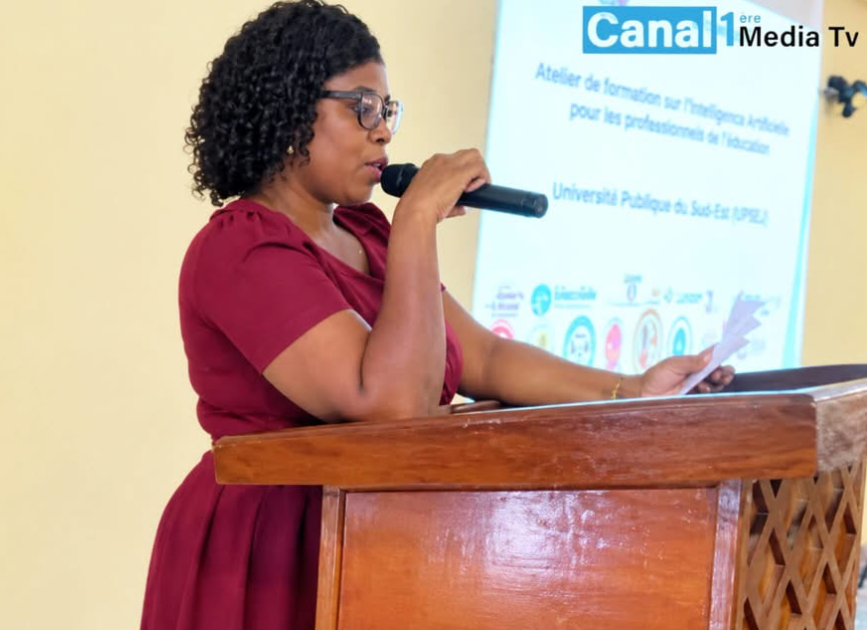
Madeleine Pierre Georges, Program Coordinator for Rethinking Power | Photo Credit: Canal 1ère Media TV
When the 16 Days of Activism against Gender-Based Violence opens each year, local gatherings do more than announce a calendar of events—they test whether institutions and community groups can turn shared concern into coordinated action. At the Jacmel launch marking the campaign, Madeleine Pierre Georges spoke before an audience spanning public institutions, civil society, women's and disability rights groups, local leaders, youth, and the media.
Her remarks focused on bridging gaps between prevention and response, removing barriers for women and girls with disabilities, and treating the 16-day window as a starting point for year-round protection and justice, and highlighted why inclusive collaboration, coordinated response, and everyday action matter alongside awareness:
“It is with great pleasure and emotion that I take the floor today, on behalf of the Rethinking Power of Beyond Borders, on the occasion of the departmental launch of the 16 Days of Activism against Gender-Based Violence against women and girls.
If we are gathered here today, it is because we share a common concern in the face of violence against women and girls, whatever their circumstances. This reality calls on all of us and reminds us that our commitment must be inclusive. Indeed, to move forward, we must join forces and ensure that no one is left behind—especially women and girls with disabilities, who can face additional barriers to accessing information, protection, and justice.
This initiative was born out of the desire to create a space where different organizations and institutions could come together, exchange ideas, and reflect collectively on how to strengthen our action against the different forms of violence against women and girls. We reached out to several organizations and institutions to invite them to join this effort. We are particularly pleased to see that every organization and institution we approached responded favorably to this invitation.
For us, this is deeply meaningful. Because it shows there is a willingness to put our heads together around an issue that concerns us all. We know that each organization has its own mission, its own priorities, and its own realities. Yet when we come together around a shared cause, we can find ways to work together while each structure continues to play its own role.
We sincerely thank all the organizations and institutions that welcomed this initiative and agreed to contribute to it.
We particularly want to highlight the central role of the Departmental Directorates of the Ministry of Women’s Affairs and Women’s Rights and the Office of Citizen Protection (OPC), who are leading this initiative alongside the Fondation Depase Fwontyè yo. The participation of the Institute of Social Welfare and Research (IBESR), as well as that of other civil society organizations, further strengthens this collective effort.
This collaboration is essential, because the fight against violence against women and girls requires concerted action between State institutions and civil society organizations, each within its own sphere of responsibility.
I would like us to take a brief moment to salute the commitment of all these institutions and organizations. Let’s give a round of applause for the Ministry of Women’s Affairs and Women’s Rights, OPC, IBESR, and all the partner organizations here with us today!
Indeed, civil society organizations are present in communities. They raise awareness, accompany survivors, mobilize people, and carry forward the concerns of those they work with. State institutions, on their side, hold essential responsibilities in protecting rights, preventing violence, and responding when violence occurs. These roles are different, yet complementary.
Within the work of Beyond Borders through the Rethinking Power Program, we work in communities to prevent violence against women and girls by implementing the SASA! Together methodology, Power to Girls, and the module "Safe and Capable" Yet we know that prevention is not enough on its own. When cases of violence occur, women and girls who are victims need to find other organizations and institutions that can receive them, accompany them, and carry out the necessary interventions. That is why collaboration among all of us is so important. Each of us has a role to play in this struggle.
We are not gathered here today to pretend that every problem can be solved in a single day. We are gathered to build bridges between different actors, to get to know better what each structure can bring, what its limitations are, and how we can coordinate our actions so that people who need services and protection receive a more appropriate response.
Because beyond speeches, awareness campaigns, and prevention actions, there are women and girls who are experiencing violence and who need to be listened to, believed, accompanied, and protected. There are also obstacles that sometimes make it difficult to access services, justice, and tailored support. That is why coordination among actors is so vital. A survivor should not have to face extra difficulties getting help due to a lack of communication or coordination between services and organizations.
We must remember that not all women and girls experience the same reality. In fact, women and girls with disabilities, for example, can encounter additional barriers when trying to get information, report violence, or access the services they need. That is why, when we think about prevention and protection, we must take into account the needs and realities of all women and all girls, without leaving anyone behind.
The theme chosen for this campaign speaks to us directly: "Let us put our heads together to contribute to ending violence against women and girls: guarantee justice, protect survivors, and end impunity."
It reminds us that our responsibility is not limited to denouncing violence. It also invites us to reflect on what each of us can do, in our own area of work, to prevent these acts of violence, better protect survivors, facilitate their access to justice, and help put an end to impunity.
During these 16 days, we will have the opportunity to raise awareness, discuss, share experiences, and reflect on the actions we can carry out. However, I would also like us to view this period as a starting point. Because violence against women and girls does not last only 16 days. Every single day we must keep working to prevent it, to protect those who suffer from it, and to ensure their rights are respected.
On behalf of the Rethinking Power Program of Beyond Borders, I would like to reaffirm our commitment to continuing this dialogue and collaboration with the civil society organizations and public institutions taking part in this initiative. We do not claim to have all the answers. But we are convinced that we can learn from one another, better coordinate our efforts, and move forward together.
Thank you for accepting the invitation. Thank you for choosing to bring your contribution to this effort. I hope that each of us leaves this gathering with a stronger determination to keep collaborating, so that our commitments do not remain mere words, but translate into concrete actions in the work we carry out every day in our communities.
Let us keep joining forces so that women and girls can live free from violence, in dignity, in safety, and with respect for their rights.”